 |

Time In London
London
is one of the world's most intriguing and beautiful cities to
spend time in. It is truly one of the world's greatest cities
by almost any measure. With a formidable collection of world famous
landmarks, parks and cultural and political institutions, London
is an amazing place to visit. It is a truly global city and a
major international center of tourism, business, entertainment,
education and the arts. It ranks with NY and Tokyo as one of the
world's major financial centers. To really understand and experience
the depth and breadth of this great city, you will need to spend
a great deal of time in London. After all, there is a vast resource
of culture and history that has accumulated over the last 2000
years - ever since London was founded by the ancient Romans, naming
it "Londinium."
The
city is not just steeped in history. It is also the place where
not only much of the history of the powerful and influential nation
of Great Britain was shaped, but also the metropolis where a great
deal of world history was also permanently changed. Whether you
go back in time to the Norman Conquest 1,000 years ago, or to the
war years around 1940, London has been a pivotal focus for national
and international events. The city has also long played an important
international role in entertainment, media and culture. It is also
an exciting city to experience. You are certain to have a memorable
time in London discovering an insight into this magnificent city
as you wander around and enjoy the sights and culture.
The
historical significance of the city is matched by its unique heritage.
Visitors are guaranteed to have a fascinating time exploring its
myriad attractions. Marveling at the Palace of Westminster and
its stateliness and grandeur next to the Thames. Exploring the
Tower of London and learning about its past. Pondering the Magna
Carta and its significance in the advancement of worldwide democracy.
Admiring the beautiful engineering of London Tower Bridge. Spending
time studying priceless antiquities in the legendary British Museum
or admiring masterpieces of art in the National Gallery. Checking
the time in front of Big Ben. Standing in awe at the pure wonder
and majesty of St Paul's Cathedral and countless other historical
landmarks.

Situated
on the River Thames, London is the capital of England and has a
population close to 8 million. However, London's population is permanently
swelled by the massive number of visitors it receives - around 14
million international travelers arrive each year. This makes London
the most visited city in the world, and with good reason! The city
has a multitude of magnificent and unique attractions. There are
World Heritage Sites such as Westminster Abbey. There are famous
landmarks like Buckingham Palace. And there are historical institutions
such as the Royal Observatory in Greenwich, home of Greenwich Mean
Time (GMT). The discerning traveler will need a great of time to
try to experience it all.
London
also has many beautiful parks to explore and relax in, such as wondrous
and tranquil Kew Gardens, one of four World Heritage sites in the
city. There are famous shopping precincts and department stores,
such as Harrods, to explore if you want to buy some clothes or gifts.
There are wonderful theaters to visit, especially in the West End,
exciting nightclubs to experience and excellent restaurants to try
all over the city. London always seems to be a key center for music
and the arts. This is truly one of the great cities of the world,
so it is no surprise that it is the world's most visited international
destination.
London Olympics
In
2005, London was selected to be the venue for the Games of the
XXX Olympiad. The Olympic Games open on 27 July 2012 and close
on 12 August and promises to be an exciting event that will captivate
the world. More than 10,000 athletes will participate in 26 sports.
The center of the Games will be in East London's 500 acre (202
hectare) Olympic Park but other world famous venues will also
be utilized, such as Wimbledon for tennis, Wembley Stadium for
football and Lord's for archery. Most venues are in one of three
Greater London zones, the Olympic Zone, the Central Zone or the
River Zone.

Special
highlights include the iconic Women's Marathon which will occur
on 5 August and Men's Marathon on 12 August. The marathons are
especially popular since you do not need a ticket! Over 9 million
tickets will be offered to witness the other sports at the Games
so that as many people as possible will be able to witness the
thrills and excitement first hand. In 2012, London will become
the first city to ever play host to three Olympic Games, having
had that honor previously in 1908 and 1948. Comprehensive details
about the 2012 Games can be found at the official website london2012.com
Climate
Travelers
planning to spend time in London will want to have an idea what
the weather might be like in advance. In mid-summer the July temperature
is likely to be around 57-74 F (14-23 C) though the climate can
vary dramatically from these guidelines. In mid-winter the chilly
January temperature is likely to be in the 36-46 F (2-8 C) range,
on average. Some days may be much colder and snow can fall on the
city any time between November and April. But if you need a change
of wardrobe, London is a shopping paradise with many famous stores
where you can buy fashionable clothes and accessories to suit every
variation in the day's climate.
London Airports
London
is the world's number one tourist destination and is served by a
number of airports, with most air traffic coming via the six main
international airports. Heathrow and Gatwick are the two major airports.
Stansted and Southend Airports in nearby Essex also serve London,
as does Luton in Bedfordshire, while London City Airport mainly
caters to business travellers and business jets.

Heathrow
Airport in West London has more international passengers in transit
than any other airport in the world, and is also ranked the world
number three in terms of total passenger traffic. Around 67 million
passengers pass through Heathrow each year. Heathrow is located
in Hillingdon which is 14 miles (22 km) west of the city center.
It has two runways and five terminals. Heathrow is served by an
express train to Paddington, the Tube and various bus, coach and
taxi services.
Gatwick
Airport is about 28 miles (46 km) south of London. It is London's
second busiest airport with around 31 million passengers carried
each year. Gatwick has two large terminals, North and South (home
to the railway station) and a people mover "monorail"
operates between them. Gatwick also boasts the largest air passenger
bridge in the world. Various bus and coach services are available
for connection with various London destinations and beyond.
Stansted
Airport is London's third busiest, with around 18-20 million passenger
visits each year, and is located 30 miles (48 km) north east of
London. Stansted has one main terminal which houses a railway station
serving London and other destinations. There are also coach and
taxi services offered.
Hotels in London
London
is the world's number one tourist destination. It's no surprise
then that the city has a vast selection of around 1500 hotels to
choose from, with a wide range of ratings to suit all budgets. These
hotels are located in a variety of places around London, and it's
well worth spending some time to make your selection to suit your
interests and your budget.
London
has a large number of exceptional five star hotels. Some are famous
around the world for their luxury and service. Some of them have
become household names, benchmarks for the finest quality of accommodation
style, standards and sophistication. In fact, there are around 100
hotels that have earned this top five star rating! A room in one
of these top establishments is sure to make your holiday time in
London highly enjoyable and memorable.
From
traditional to modern in style, the choices are exceptional - just
a select few of these great and highly rated hotels are listed here.
Claridge's Hotel in Mayfair, famous for its Art Deco style and history.
The Savoy Hotel on the Strand, Westminster, a household name and
renowned since 1889. The Ritz Hotel at Piccadilly in the West End
with its famously beautiful restaurant. The InterContinental Hotel
Park Lane, close to Buckingham Palace. The Mandarin Oriental Hotel
at Hyde Park, close to Harrods and shopping boutiques.
The
Hilton Waldorf, close to the West End and the financial district.
The Milestone Hotel in Kensington Court, famous for luxury. The
Marriott West India Quay Hotel, located at Canary Wharf. The Marriott
Hotel County Hall at Westminster Bridge near London Eye and other
attractions. The Stafford Hotel in St James's, close to Bond Street.
The Soho Hotel, centrally located in Richmond Mews. The Dorchester
Hotel on Park Lane, opposite Hyde Park. These are just a select
few of much more than 1000 hotels in London!
|
|
|

 |

Palace of Westminster
The
Palace of Westminster is an exceptional complex of buildings in
the Perpendicular Gothic architectural style forming a grand quadrangular
shape. Magnificently located on the River Thames in the City of
Westminster near the Westminster Bridge, this is the official meeting
place of both houses of Parliament, the House of Lords and the House
of Commons. It is commonly referred to as the "Houses of Parliament".
Visiting here is a highly rewarding way to spend time in London.
 In
1834 a devastating fire destroyed much of the previous complex
leading to the commencement of the present building's construction
in 1840. In 1987 it became recognized as part of a UNESCO World
Heritage Site listing in association with Westminster Abbey and
St Margaret's Church. The site's architecture is not the only
reason for it's fame — it is also highly significant for
social and political reasons — the phrase "Westminster
system of government" derives from the Houses of Parliament
here. In
1834 a devastating fire destroyed much of the previous complex
leading to the commencement of the present building's construction
in 1840. In 1987 it became recognized as part of a UNESCO World
Heritage Site listing in association with Westminster Abbey and
St Margaret's Church. The site's architecture is not the only
reason for it's fame — it is also highly significant for
social and political reasons — the phrase "Westminster
system of government" derives from the Houses of Parliament
here.
The
Palace of Westminster is a huge complex and an essential destination
for London visitors. There are two main towers which feature architecturally
on the site. One of these is Victoria Tower, which has the impressively
grand height of 323 feet (98 meters). It has several functions,
such as being a repository for the Parliamentary Archives which
contain more than three million documents. It also features the
Sovereign's Entrance which is used by the reigning monarch for state
occasions such as the opening of parliament. The original Bill of
Rights is stored here, along with so much more of English history.
Buckingham
Palace
Buckingham
Palace is a grand building in the City of Westminster and the primary
residence of the British monarch. It has been a focal point of royal
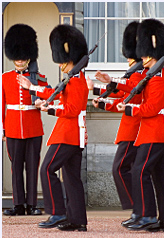
and state occasions since 1837. The Changing of the Guard is held
in the Forecourt, and this exciting occasion has been the highlight
of many a traveler's time in London. Investitures are held in the
palace Ballroom, which at 120 feet (37 meters) long, is the biggest
room in the palace. Special Note — some interior parts of the
palace are only open to the public during the English summer.
In
front of the palace is the magnificent Victoria Memorial, dedicated
to Queen Victoria. Victory is featured on the pinnacle with other
beautiful figures also featured such as the Angel of Truth. The
statue is in The Mall, a ceremonial approach linking Admiralty Arch
to the forecourt of the palace which witnesses cavalcades and special
occasions such as Trooping the Colour. This is a spectacular annual
parade performed by British and Commonwealth regiments and their
horses, with around 400 musicians and a 41 gun salute.
Behind
the palace is London's largest private garden. This is where large
summer garden parties are held and special occasions marked. The
Royal Mews, home of the carriage horses and the world famous Gold
State Coach, is adjacent to the palace.
Buckingham
Palace was bombed during World War II, and the most significant
damage sustained was the destruction of the chapel. That site was
later used to build the Queen's Gallery where selected works from
the Royal Collection are held. The gallery is open to the public.
The Queen's stoicism after that challenging disaster proved to be
a great boost to public morale at the time.
British Museum
The
British Museum collection of over 7 million objects represents a
comprehensive repository of human history and culture from around
the globe. The British Museum is located in Great Russell Street
and is open seven days a week. Admission is free to all, and with
such a wondrous, exciting and educational collection, a visit to
the museum is a fun and rewarding way to spend time in London.
 The
British Museum had its origins in a bequest of more than 70,000
objects by Sir Hans Sloane to King George II. The museum was subsequently
established in 1753 by an Act of Parliament. Acquisitions and
bequests have continued to build up this very fine collection
to this day. World wide field trips from 1840 also contributed
(as well as making a number of very significant archaeological
discoveries). The
British Museum had its origins in a bequest of more than 70,000
objects by Sir Hans Sloane to King George II. The museum was subsequently
established in 1753 by an Act of Parliament. Acquisitions and
bequests have continued to build up this very fine collection
to this day. World wide field trips from 1840 also contributed
(as well as making a number of very significant archaeological
discoveries).
In
1802 the museum had already outgrown its original location in Montagu
House, and Sir Robert Smirke was commissioned to commence the neoclassical
quadrangular building design that we admire today. With a grand
public entrance and imposing presence, the museum features 44 ionic
columns. Inside, there are almost 100 galleries on display.
The
British Museum has a number of diverse and important departments
covering important periods of human history and culture. Only Egypt
has a more comprehensive collection of Egyptian antiquities than
The Department of Ancient Egypt and Sudan, covering thousands of
years of culture from the Nile region. The Department of Greek and
Roman Antiquities has an extensive collection from the Classical
world dating from the Greek Bronze Age 5000 years ago. And the Department
of Prehistory and Europe has a collection dating back 2 million
years to prehistoric times.
Other
important departments focus on the Middle East, Asia, Africa, Oceania
and the Americas, a testament to the unsurpassed diversity and comprehensive
breadth of the museum's superb collection.
Natural History
Museum
The
Natural History Museum in South Kensington opened in 1881 in the
Alfred Waterhouse building, a grand example of Victorian architecture
and a fine London landmark. Myriad terracotta tiles illustrate the
wide diversity of Mother Nature with relief sculptures of flora
and fauna. The ornate exterior is matched by the imposing scale
of a spacious main hall inside featuring natural lighting from skylights
above.
The
museum possesses around 70 million specimens from all corners of
the globe which feature in its displays, educational programs and
research. The historical and scientific value is immense, with some
specimens even having been collected by Charles Darwin (who is also
recognized by the museum in the form of a fine statue). The exhibits
are broadly categorized into five main collections: Botany, Entomology,
Mineralogy, Palaeontology and Zoology.
The
Natural History Museum is particularly famous and popular for its
displays of dinosaur skeletons, especially the gigantic Diplodocus
cast which is 105 feet (32 meters) in length. "Dippy"
the Diplodocus (as it is called) casts a spell over the large hall
it resides in. The museum also has countless other superb displays
to learn from, and you will need to allocate lots of time in London
to do justice to the vast collection and entertaining displays.
Imperial War
Museum
The
Imperial War Museum in London has been located in the majestic former
Bethlem Royal Hospital in Southwark since 1936. From it's earliest
days, it was intended to record in a personal way the hard work
and sacrifice of the participants, rather than being a mere impersonal
record of the glory of war. The museum's fine and vast collection
comprehensively covers the various military conflicts of the British
Empire in the 20th and 21st centuries. The museum has a number of
other branches in England, including HMS Belfast (a Town class cruiser
which served throughout World War II) and the Churchill War Rooms
(an underground command center) in London.
 Two
massive 15 inch guns stand impressively at the front of the museum.
Being a former hospital, the building's courtyard was converted
into the Large Exhibits Gallery to suit the needs of a major museum.
Here, you can see superb historical exhibits such as a Sopwith
Camel, Mark V and Grant tanks, Polaris missiles and a multitude
of other ordnance and items. Other highlights of the museum's
extensive collection of more than 10 million objects include Victoria
Crosses and other medals, soldiers' diaries and a colt pistol
owned by wartime Prime Minister Winston Churchill. The museum
supports a superb website at iwm.org.uk
where you can search in advance for detailed info and pictures
via the "Collections and Research" button. Two
massive 15 inch guns stand impressively at the front of the museum.
Being a former hospital, the building's courtyard was converted
into the Large Exhibits Gallery to suit the needs of a major museum.
Here, you can see superb historical exhibits such as a Sopwith
Camel, Mark V and Grant tanks, Polaris missiles and a multitude
of other ordnance and items. Other highlights of the museum's
extensive collection of more than 10 million objects include Victoria
Crosses and other medals, soldiers' diaries and a colt pistol
owned by wartime Prime Minister Winston Churchill. The museum
supports a superb website at iwm.org.uk
where you can search in advance for detailed info and pictures
via the "Collections and Research" button.
The
museum has eight departments. The Department of Exhibits and Firearms
maintains a collection of artillery, vehicles, aircraft, ordnance
and medals. The Photograph Archive's 6 million images record in
detail the two world wars and later conflicts. The Film & Video
Archive maintains the official visual British record of the world
wars. Oral history recordings and wartime broadcasts are notable
features. A variety of manuscripts, diaries, letters and records
are preserved by the Department of Documents. Other departments
cover the fields of Art, Printed Books (including important maps)
and Holocaust & Genocide History.
Victoria &
Albert Museum
The
Victoria and Albert Museum (V&A), with its collection of more
than 4 million objects, is the world's leading repository of decorative
arts and design. The collection, assembled in 145 galleries, covers
5,000 years of human cultural and artistic history in just about
every field of artistic design.
There
are comprehensive collections of sculpture, ceramics, glassware,
furniture, jewelry, metalwork, textiles, fashion, medieval objects,
prints and printmaking and more. The displays are certain to enthrall
visitors and inspire creative people from around the world. The
V&A has a stated aim to enable visitors to "explore the
cultures that created them" and it surely succeeds.
There
are more than 200,000 paintings and drawings in the V&A, and
the vast and diverse collection is priceless and superb. Artists
represented include Rembrandt, Cezanne, Raphael, Turner, Degas,
Durer and Botticelli. Oil paintings, watercolors, miniatures, drawings
and prints from many eras and cultures are well represented. The
works are inspiring and educational, so time in the V&A will
be well spent.
To
focus on just one section for example, the V&A's photographic
collection of over 500,000 images is extensive and dates from 1839,
which was very early days in this field. Photographers like Fox
Talbot, Henri Cartier-Bresson and Man Ray are among many artists
represented. You can even see an early example of Eadweard Muybridge's
animal motion series.
Science Museum
The
Science Museum had its origins in 1857 as part of the then South
Kensington Museum, and attained its independent status in 1909.
Its current buildings were constructed in the decade after World
War I. The museum now contains more than 300,000 items in its vast
collection. Many areas of science and engineering are represented,
from engines to medicine, from technology to flight. The museum
holds a formidable collection of scientific and historical objects.
One
of the most famous exhibits is Stephenson's Rocket (a steam engine)
built in 1829. It was such a technological breakthrough at the time,
with its innovations and design, that it set the standard for steam
locomotives henceforth. For example, the number of boiler tubes
was increased from one to 25, which greatly increased the volume
of steam generated, and hence the power.
Flight
is also very well represented at the museum. Among the airplanes
and helicopters exhibited are Spitfire and Hurricane fighters,
as well as Alcock and Brown's 1919 Vickers Vimy which crossed
the Atlantic Ocean non-stop in that year. Jumping ahead in time,
the museum is also home to the Apollo 10 command module which
voyaged around the moon in 1969 in a rehearsal for the moon landing.
These are just a few samples of the fun and educational exhibits
of special interest to families at the Science Museum.
National Maritime
Museum
Located
in Greenwich Royal Park, the National Maritime Museum's grand buildings
and spacious garden setting are wonderful places to visit in London.
The museum covers Britain's rich naval history and heritage from
the 16th to the beginning of the 20th century and possesses more
than 2 million objects. The museum's superb displays include maritime
maps, paintings & portraits, manuscripts, plans, instruments
and models. It also holds the world's largest historical maritime
library dating back more than 500 years.
 Highlights
of the museum's collection include comprehensive holdings relating
to the lives and achievements of Captain James Cook and Vice-Admiral
Horatio Nelson. Of special interest to children are the models
of ships from various eras. Highlights
of the museum's collection include comprehensive holdings relating
to the lives and achievements of Captain James Cook and Vice-Admiral
Horatio Nelson. Of special interest to children are the models
of ships from various eras.
Since
time measurement is such an important aspect of navigation, chronometers
are presented on display. It was at Greenwich that Charles II established
the Royal Observatory with the intention of helping mariners with
their navigation, set their clocks, find their longitude and observe
a universal time system.
Greenwich,
besides being important as the center of GMT and marker of the Prime
Meridian, also has a rich naval history. Centuries ago it had been
a Roman landing place, and the British Navy can also trace some
of its origins to the area.
Kew Gardens
The
Royal Botanic Gardens, Kew is a magnificent complex of spectacular
gardens, glasshouses and buildings in south west London, situated
on the Thames. Kew Gardens maintains a vast collection of living
plants and covers 299 acres (121 hectares). The herbarium holds
more than 7 million preserved specimens, there are more than 750,000
volumes in the library and more than 175,000 plant prints and drawings
in the illustration collection. Exploring the Gardens is a truly
enjoyable and relaxing way to spend rewarding time in London.
Founded
in 1759, the site contains some of the finest examples of the art
of gardens created in the last two and a half centuries. The Gardens
also contains some important and historical buildings, for example,
Temperate House, the world's largest Victorian glass building still
in existence, which took 40 years to build. And, Kew Gardens has
made a great contribution to the sciences of botany, ecology, horticulture,
plant classification, seed preservation and plant diversity through
its ongoing research, educational programs and international cooperation.
Kew
Gardens has many wonderful features, and you will need to allocate
lots of time to do them justice. There is a beautiful variety of
plants to admire in the many specialist gardens, designed landscapes
and ornamental lakes. The Arboretum contains more than 14,000 trees
and spans more than half the area of the Gardens. The Treetop Walkway
is 59 feet (18 meters) tall and takes you through a tree canopy.
The Aquatic Garden, more than 100 years old, contains a wide selection
of waterlilies and aquatic plants. There is an extensive Carnivorous
Plant Collection and a compelling Orchid Collection in the impressive
Princess of Wales Conservatory, which contains 10 micro-climatic
zones. The Rose Garden is a particularly beautiful display of superb
roses.
The
Gardens is perhaps equally famous for its historic buildings.
Palm House and Temperate House are magnificent glasshouses constructed
with iron frames. Palm House has a walkway 29.5 feet (9 meters)
tall so you can view the palm tops. Temperate House contains plants
from all the world's major temperate regions. Kew Palace dates
from around 1631 and is adjacent to the "Queen's Garden".
Beautifully situated on a lake, Museum No. 1 was designed to represent
humanity's dependence on plants and has an excellent collection
of economic botany exhibits. The Orangery is a classical style
building dating from 1761, and is now a restaurant where you can
relax for lunch or afternoon tea.
|
 |
|

|
Greenwich
Maritime
Greenwich is an unforgettable group of historic buildings in a park
setting next to the Thames. The scientific and architectural significance
is immense. The site is a paradigm of the pinnacle of English creative
and scientific achievements in the 17th-18th centuries. The Renaissance
style Queen's House, designed by Inigo Jones, was England's first
Palladian building. He was also one of the architects of the Royal
Hospital. A design for the Royal Park was devised in 1662 by the
famous French landscape architect André Le Nôtre.
View
Larger Map
The
Old Royal Observatory sits on a hill in Greenwich Park. The observatory
was commissioned by King Charles II in 1675 with the aim of advancing
the strategically important sciences of astronomy and navigation.
This is the most famous place in the world for time measurement
and the origin of what became a very important world standard of
enormous significance.
Greenwich
is synonymous with the measurement of time and is most famous for
Greenwich Mean Time (GMT), the baseline for the international time
zone system. GMT is the abbreviation given to London's time zone
(current London time is displayed at the top of this website.) Special
Note: GMT designates official winter time in London. In summer,
it technically becomes British Summer Time (BST). For BST, time
is advanced by one hour from GMT on the last Sunday in March until
the last Sunday in October.
 The
historic settlement also marks the Prime Meridian which is defined
as being 0 degrees longitude. (The International Date Line in
principle follows its opposite - the 180th meridian). The Greenwich
Meridian had first been established in 1851. In 1884, 25 nations
met in the USA for the International Meridian Conference and Greenwich
was selected as the Prime Meridian. The
historic settlement also marks the Prime Meridian which is defined
as being 0 degrees longitude. (The International Date Line in
principle follows its opposite - the 180th meridian). The Greenwich
Meridian had first been established in 1851. In 1884, 25 nations
met in the USA for the International Meridian Conference and Greenwich
was selected as the Prime Meridian.
Tower Bridge
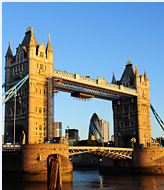
London's
famous Tower Bridge on the River Thames was opened in 1894. The
bridge originally used steam power to operate the moveable sections.
That has been replaced by modern hydraulic motors. Because the passage
of tall masted ships was so important to London commerce at the
time, a very special bridge design was required. You can still see
the original magnificent steam engines in the museum at the south
end.
Tower
Bridge has a "double leaf" drawbridge section balanced
by counterweights that lift up to facilitate river traffic. This
is an important part of its fascination for tourists and wonderful
to see if you have some spare time in London. Each leaf weighs more
than 1000 tons and is around 100 feet (30 meters) long. They are
opened about 1000 times each year.
To
complete the engineering, two walkways link the solid towers high
above the water. These have beautiful London views and are also
used for exhibitions. The towers have a decorated Victorian Gothic
appearance, intended to echo the style of the nearby Tower of London
from which it took its name. And suspension sections link the central
drawbridge section with the river shores, helping to give Tower
Bridge its unique character.
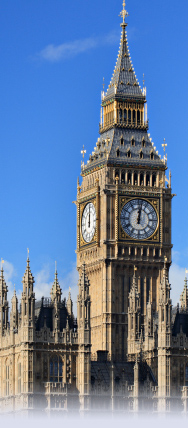
Big Ben
The
Clock Tower at the Palace of Westminster, famously known as "Big
Ben", stands 316 feet tall (96 meters). It is one of the most
iconic symbols of London and probably the most famous clock in the
world. It is the world's largest four face bell ringing clock. The
tower was designed in a Gothic Revival style by Augustus Pugin at
the request of Sir Charles Barry, the Parliament's chief architect.
Big
Ben contains the Great Clock of Westminster which has served astonishingly
accurate time for Londoners since 1859. The hour hands are almost
9 feet (2.8 meters) in length! When in Westminster you have no excuse
not to know the correct time in London! Big Ben's movement is famous
for its accuracy. The pendulum alone weighs 660 pounds (300 kg)
and is 12.8 feet long (3.9 meters).
The
"Big Ben" moniker originally came from the unofficial
nickname for the largest bell, The Great Bell of Westminster, which
is used to strike the hour. Four smaller quarter bells play the
Westminster Quarters every 15 minutes. The ringing of the bells
is a popular tradition in the city.
Tower of London
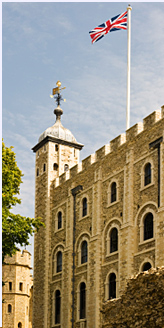
The
Tower of London was built at a strategic location on the Thames
by William the Conqueror. Its purpose was to both protect and control
the capital of the new Norman kingdom through its location and garrison,
thus consolidating his power. The Tower is essentially a palace
within a fortress.
 The
Tower of London has played a very important role in British and
European history. For example, the disappearance of Edward V and
his brother Richard of Shrewsbury (the "Princes in the Tower")
in the 15th century, and the imprisonment of four queens in the
16th, changed the course of history and that of the Royal Family.
Three of those queens were executed. Sir Thomas More was imprisoned
for treason in 1535 and beheaded, only to become a saint later. The
Tower of London has played a very important role in British and
European history. For example, the disappearance of Edward V and
his brother Richard of Shrewsbury (the "Princes in the Tower")
in the 15th century, and the imprisonment of four queens in the
16th, changed the course of history and that of the Royal Family.
Three of those queens were executed. Sir Thomas More was imprisoned
for treason in 1535 and beheaded, only to become a saint later.
The
Tower is also steeped in mystery. The "Princes in the Tower"
disappeared without a trace. One of the most fascinating aspects
of the Tower is the legend of the Ravens, and this story has stood
the test of time. They have resided there for centuries and receive
extra special care, because according to legend, if the Ravens ever
leave, the kingdom will fall.
The
legendary Crown Jewels have been kept in the Tower of London since
1303. The regalia and apparel are worn by the king or queen at important
state functions and coronations. The term refers to a precious collection
of crowns, swords, sceptres, robes and other royal items. Their
history, value and design hold immense fascination for those who
view them. For example, the Imperial State Crown contains more than
3,000 jewels, mostly diamonds. One of these is a famous named diamond,
the Cullinan II, a.k.a. "The Lesser Star of Africa."
Westminster
Abbey
Westminster
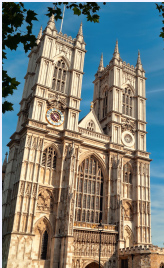
Abbey is a magnificent Anglo-French Gothic style church located
in the City of Westminster, London. It is believed to have originated
as an abbey around the year 970, but construction of the present
church was begun in 1245 by Henry III in honor of the Royal Saint
Edward the Confessor. The two western towers were added in the first
half of the 18th century. The Abbey is one of the great landmarks
of London, with its epic architecture, inspiring scale and sense
of historical significance.
Tradition
has it that the Abbey is the venue for Royal coronations and burials.
Coronations have been held there since 1066. Royal weddings are
often held there as well. Most English kings and queens are buried
in Westminster Abbey. Over time, a tradition grew for other prominent
and admired people to be interred there as well, such as poets,
soldiers, scientists and politicians. Notable people whose final
resting place is in the Abbey include Geoffrey Chaucer, William
Blake, Charles Dickens and the Bronte Sisters. Of special note is
the tomb of The Unknown Warrior, interred on Armistice Day, 1920.
The
Abbey has a museum in one of its oldest sections which dates back
to the 11th century. Adjacent to the abbey is the beautiful St Margaret's
Church, founded by Benedictine monks in the 12th century and rebuilt
in the decades around 1500. The historic church features stained
glass windows dedicated to various famous people including John
Milton and Sir Walter Raleigh.
St Paul's Cathedral
St
Paul's Cathedral is one of London's most treasured icons. It's design
and scale are a testament to the skills of its designer Sir Christopher
Wren who was commissioned to design it in 1669. It was officially
opened in 1697.
St
Paul's is a Church of England cathedral and serves the Diocese of
London. It features a very large dome balanced by two towers and
other stylish architectural elements in an English Baroque design
of the late Renaissance, and sits very impressively on the City
of London's highest point. It is Standing 365 feet high (111 meters)
the cathedral was London's tallest building for several centuries.
Equally impressive is the awe inspiring interior, it's incredible
to see the unbelievable interior of the dome — rising 213 feet
(65 meters) above the floor.
The
cathedral's long history can be traced back to 604 AD, when a church
dedicated to Paul the Apostle was believed to have been founded.
Since those days it has been the venue for many important events
in British history, such as the wedding of Prince Charles and Princess
Diana.
The
cathedral had special significance for Londoners during the Blitz
of WWII. It miraculously survived major damage from sustained bombing
against London, and came to symbolize the resilience of the British
war effort, boosting morale. It was in fact struck by bombs in 1940
and 1941.
Shard London
Bridge
"The
Shard" (to use its popular name) in Southwark is 1016 feet
(309.6 meters) tall — making it the tallest building in the
European Union. The basic structure was completed in April 2012.
Its spectacular style and beauty is a genuine sight to behold,
with its apex seeming to disappear into the sky overhead. Its
viewing area and observation deck on the 72nd floor promises to
give a truly spectacular vision of London when it opens in February
2013. (The building proper opened to the public in July 2012,
nicely timed for the Olympics).
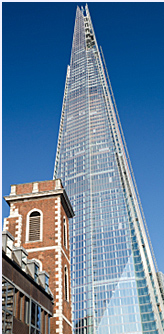 The
Shard's grand style is like a tall, elongated triangular shaped
pyramid. It has an impressive 72 floors for human activity which
includes office space and a hotel. Its formidable presence is
inspiring and colossal. The tower is clad in glass, allowing the
walls to reflect the sky and the sun and the seasons and the clouds
and the city, resulting in a startling new asset for this amazing
metropolis. Somehow, the building succeeds in being both new and
classic at the same time, a convergence of the Ancient and the
Modern, a remarkable architectural achievement. The
Shard's grand style is like a tall, elongated triangular shaped
pyramid. It has an impressive 72 floors for human activity which
includes office space and a hotel. Its formidable presence is
inspiring and colossal. The tower is clad in glass, allowing the
walls to reflect the sky and the sun and the seasons and the clouds
and the city, resulting in a startling new asset for this amazing
metropolis. Somehow, the building succeeds in being both new and
classic at the same time, a convergence of the Ancient and the
Modern, a remarkable architectural achievement.
The
Shard was designed by the internationally renowned architect Renzo
Piano. The cost of the building was 450 million pounds. Renzo Piano
likened the building concept to a "shard of glass" —
ultra modern in scope yet paying tribute to the old church steeples
that can be seen in old engravings of London. The angled panes of
glass that clad the building reflect the surroundings to soften
the footprint of what is in fact a very large building of 1,200,000
square feet (110,000 square meters). On The Shard's website, Renzo
Piano provides an apt description for this major world architectural
monument: "This is my vision: I foresee the tower as a vertical
city, for thousands of people to work in and enjoy, and for millions
to take to their heart."
British Library
The
British Library in St Pancras became separate from the British Museum
in 1973. The library's colossal collection has 14 million books
and more than 130 million additional items including manuscripts,
newspapers, sound recordings, patents, stamps, maps, prints and
drawings. Every country in the world is represented. Ancient and
historical items date back about 3 thousand years, making the library
one of the world's most important historical repositories.
Various
important books and priceless manuscripts are on special public
display. Visitors may be able to see a Gutenberg Bible, Charlotte
Bronte's Jane Eyre, a notebook of Leonardo da Vinci or a 1215 copy
of the Magna Carta. Other highlights of the library are the King's
Library (books, manuscripts and maps collected by King George III),
the Sound Archive containing more than a million recordings from
the last 100 years and the Philatelic Collections, a formidable
collection of international stamps and materials.
The
library also has a Newspapers section (located in Colindale) containing
a near complete collection of British newspapers dating from 1840,
and thousands dating long before that. This is a significant historical
resource for researchers.
National Gallery
The
National Gallery, with a grand and stately entrance at Trafalgar
Square, was founded in 1824, and its collection represents the art
of painting in the time period from the 13th century up to 1900.
(Later art is held at Tate Modern).
The
initial focus was on works from the High Renaissance but that soon
expanded following acquisitions and bequests into a more representative
collection of premium art movements in Europe and Britain. The stately
gallery building itself underwent expansion over the years. Today,
you can enjoy interesting tours, relax with a delicious lunch in
the National Dining Room or buy a print of your favorite painting.
 The
gallery experienced a drama of sorts during World War II when
the paintings were evacuated to a quarry in North Wales for safety
in case of bombing. But during the last few years, just one sole
painting was retrieved from the quarry each month for public display
at the Gallery, a symbol of defiance that helped keep public morale
high during that time. The
gallery experienced a drama of sorts during World War II when
the paintings were evacuated to a quarry in North Wales for safety
in case of bombing. But during the last few years, just one sole
painting was retrieved from the quarry each month for public display
at the Gallery, a symbol of defiance that helped keep public morale
high during that time.
Masterpieces
in the National Gallery include The Virgin of the Rocks by Leonardo
da Vinci, The Fighting Temeraire by J M W Turner, Belshazzar's Feast
by Rembrandt van Rijn, Les Grandes Baigneuses by Paul Cezanne, The
Entombment by Michelangelo, Sunflowers by Vincent van Gogh and The
Thames Below Westminster by Claude Monet.
Tate Modern
Tate
Modern resides in a former power station (completed in 1963) in
Bankside, Central London. It holds an exceptional collection of
international modern art dating from 1900, complementing the period
covered by the National Gallery. Spending time in Tate Modern is
extremely popular, with almost 5 million visitors each year. On
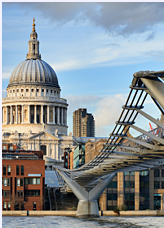
a fine day, you can walk across the Millennium Bridge from St Paul's
Cathedral and enjoy spectacular views. Or visit on a relaxing passenger
boat from Greenwich or Docklands.
Many
important movements are covered from Abstract Expressionism to Surrealism,
from Cubism to Futurism, From Arte Povera to Expressionism, from
Abstraction to Pop Art. A wide range of artists are represented
including Salvador Dali, Max Ernst, Georges Braque, Edvard Munch,
Marcel Duchamp, Roy Lichtenstein, Henri Matisse, Hans Hartung, Joseph
Beuys, Alberto Giacometti, Man Ray, Claude Monet and Andy Warhol.
These artists provide a fine representative overview of modern art.
30 St Mary
Axe
A beautiful,
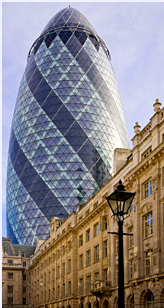
award-winning skyscraper was completed in the City of London (the
city's financial district) at 30 St Mary Axe in 2004. The building
stands 591 feet (180 meters) in height, and is sometimes unofficially
called the Swiss Re Tower after its principal tenant. It is more
frequently and popularly called "The Gherkin" because
of its unique and beautiful style. London has an impressive historical
heritage, but this ultra modern building is testament to the fact
that the city is also looking towards the future.
The
building features a beautiful harmonious and curved shape that narrows
towards the top, slightly resembling an old rocket ship. Enhancing
the structural shape, the exterior has a pleasing criss-cross design
that contributes to its organic appearance. This is visually very
impressive due to the scale of the building which at 40 floors,
is not insignificant. The skyscraper has deservedly won numerous
important architectural awards for its ground breaking design.
|
|
|


|




